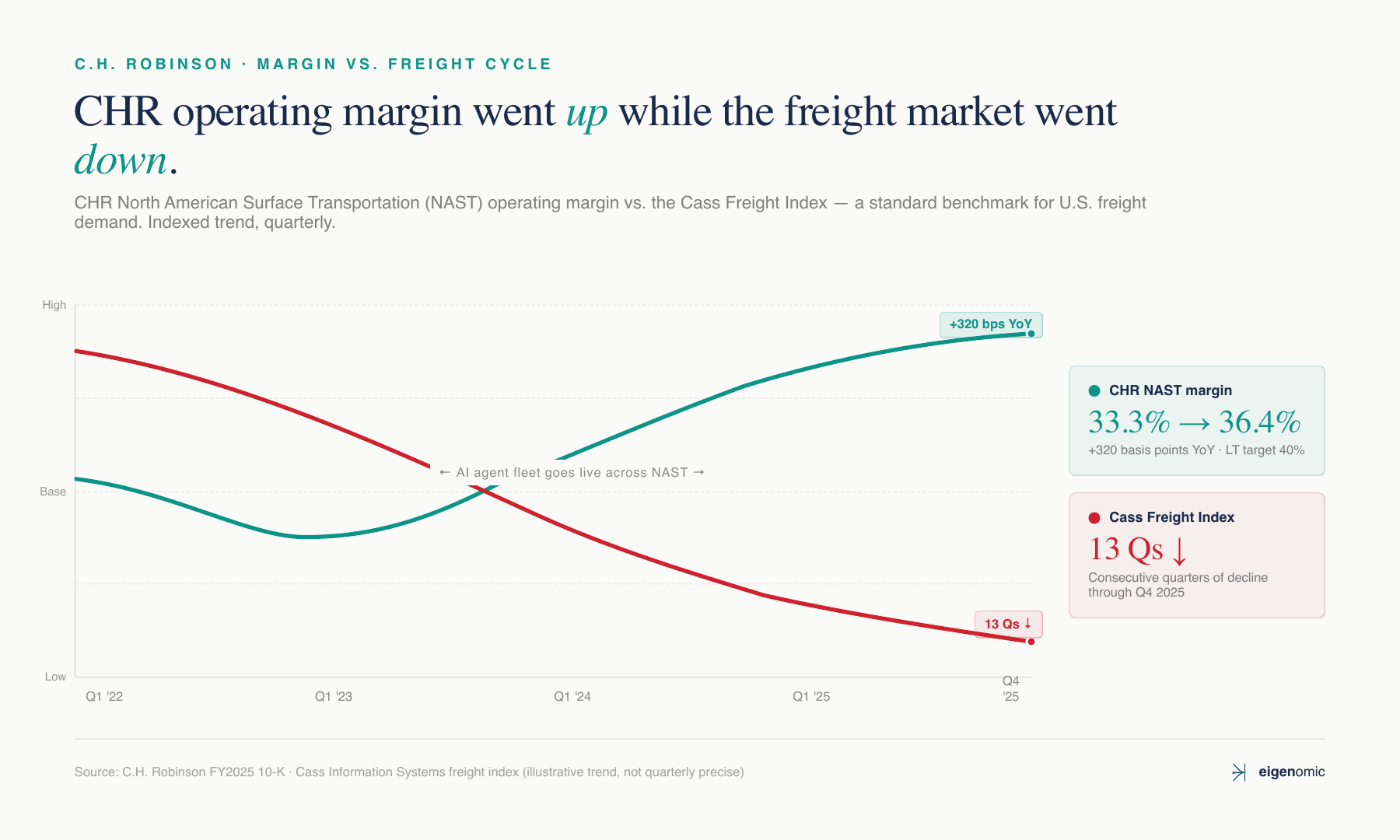
Most AI transformation stories are in press releases. C.H. Robinson’s story was in their earnings call: they expanded 320 basis points of operating margin during a 13-quarter freight recession.
Background
C. H. Robinson is the largest freight broker in North America — a $17B public company that doesn’t own a truck. They sit between ~70,000 shippers (companies with stuff to move) and ~80,000 carriers (people with trucks that can move stuff), matching loads to capacity and taking a margin in the middle.
For 20+ years their operating model has run on email: a shipper emails a quote request, a human reads it, looks up rates, replies, gets approval, books a truck, monitors the load, and occasionally handles exceptions.
Every email is a little different, which is why they could not automate their intake process. Until now.
The 320 basis point solution
Step 1: Parse the email (the LLM part)
Large language models — from OpenAI, Anthropic, and others — can read unstructured text like emails and turn them into structured tabular data.
This is what the engineers at C. H. Robinson started with. They built a fleet of agents that turn inbound emails into structured quote requests: lane, equipment, weight, pickup window, special handling (if any).
Step 2: Price it (math, and it’s been there for years)
Once the email is parsed into a structured request, CHR uses infrastructure they have been building for two decades: Navisphere (their TMS) and Procure IQ (their pricing engine), pulling from data on 200,000+ shippers and carriers.
The pricing engine computes a quote using historical rates, current spot capacity, fuel index, target margin. Per CFO Damon Lee: a human salesperson uses “5–10 data points.” The pricing layer uses “tens of thousands, if not hundreds of thousands.”
This is not generative AI. It’s pure math that’s been quietly compounding inside Navisphere since long before ChatGPT.
Step 3: Match the carrier (also pre-existing math)
Once the shipper accepts the quote, Navisphere Optimizer scans the carrier network and tenders the load to the best match. Something CHR has been doing for years.
Step 4: Execute (mix of LLMs and math)
Pickup and delivery appointment scheduling, in-transit tracking, exception alerts, and increasingly the status updates back to shippers — these have been getting absorbed by the agent fleet. This is where LLMs are most useful again, because every carrier and warehouse communicates differently.
Why intake speed is the dollar
The numbers from CHR’s own disclosures:
- 5,500 shipment orders/day created from inbound emails (90 seconds per batch of 20)
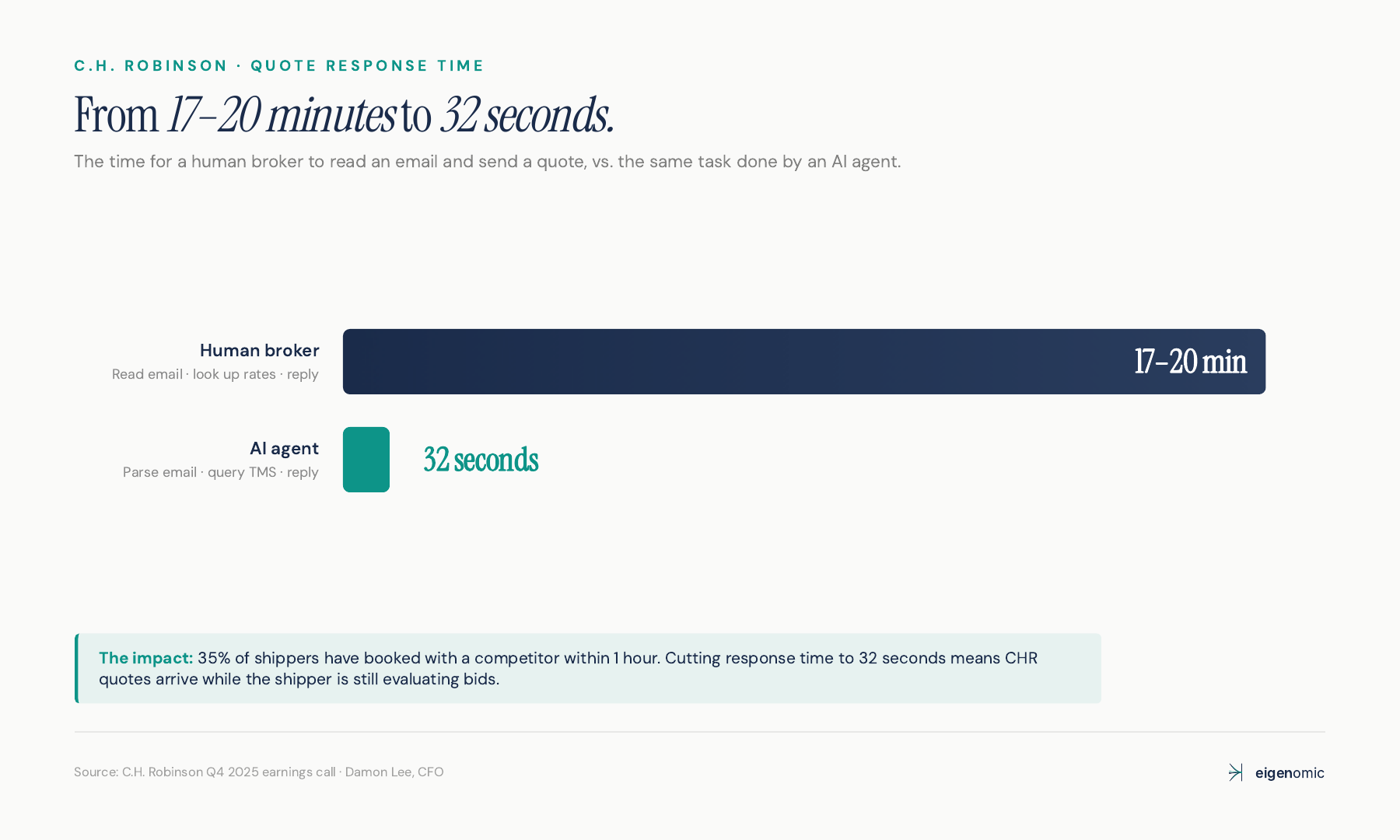
- 2,600 quotes/day delivered via AI at 32 seconds each, down from 17–20 minutes for a human
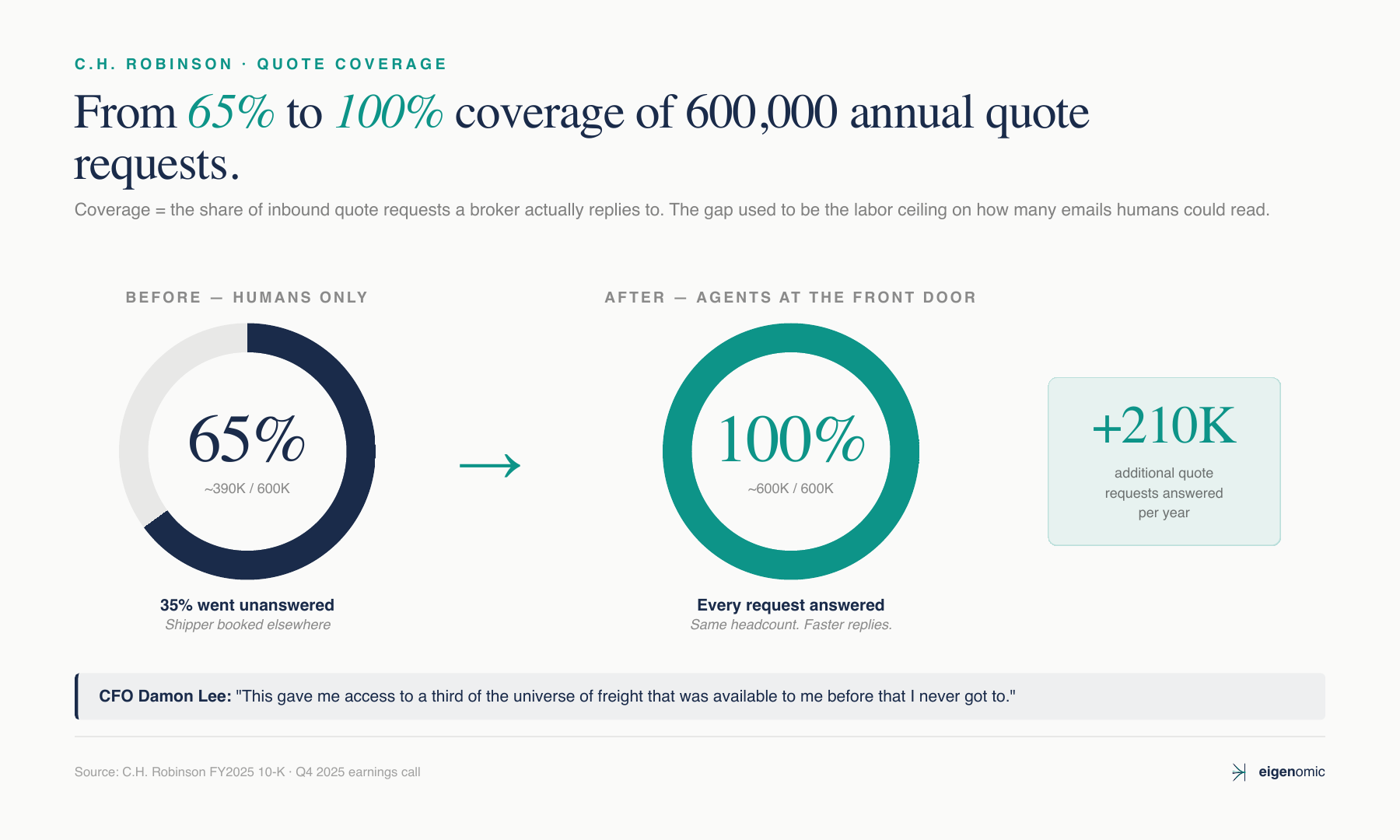
- Coverage went from 60–65% of ~600,000 annual quote requests to 100%
CFO Damon Lee’s framing: this gave them access to “a third of the universe of freight that was available to me before that I never got to.” They didn’t just speed up the work — they unlocked a third of their total addressable market that humans literally could not get to.
The pricing engine was already excellent. The carrier network was already 200k strong. The optimization math was running. What was missing was throughput at the front door — humans could only read so many emails.
When they removed this bottleneck, two things happened at once:
- Quotes started arriving while the shipper was still evaluating bids, instead of after they’d booked somewhere else.
- Coverage of emails went from 65% answered to 100% answered. A third more shots on goal, without additional headcount.
The scoreboard
The receipts are in the P&L:
- NAST operating margin: 33.3% → 36.4% YoY
- Productivity: +40% shipments per person per day in NAST since 2022; +55% in Global Forwarding
- All of this during a freight recession — the Cass Freight Index has fallen 13 successive quarters
What this means if you’re not C.H. Robinson
CHR may not be replicable as a whole, but the pattern is.
Most operations-heavy mid-market businesses whose work begins as an inbound email or PDF — distributors, 3PLs, insurance MGAs, claims administrators, law firms — already have a Navisphere-equivalent. A core system, a pricing model, an underwriting engine, a matter-management workflow. The math layer mostly works.
What’s broken is the front door.
The pattern that worked at CHR:
- Pick the unstructured intake choke point (email, PDF, fax).
- Build a parser that turns it into structured tasks.
- Wire the parsed task into the system you already have. Don’t replace the operating system.
- Let the math / ML / optimization that already lives in that system do its job, now without a human gate.
- Measure cost-to-serve, not “AI usage.”
You don’t need 450 engineers and 20 years of optimization R&D. You need to attack one workflow and refuse to declare victory until margins move.
CHR’s CEO put it cleanly: “We are the new disruptor.”
Real disruption shows up in earnings, not in headlines.
Disclosure: All credit for this success goes to CHR’s internal team. Eigenomic did not work on this engagement.